Modern Pharmaceutical Marketing Strategies to Increase Market Share of Pharmaceutical Companies
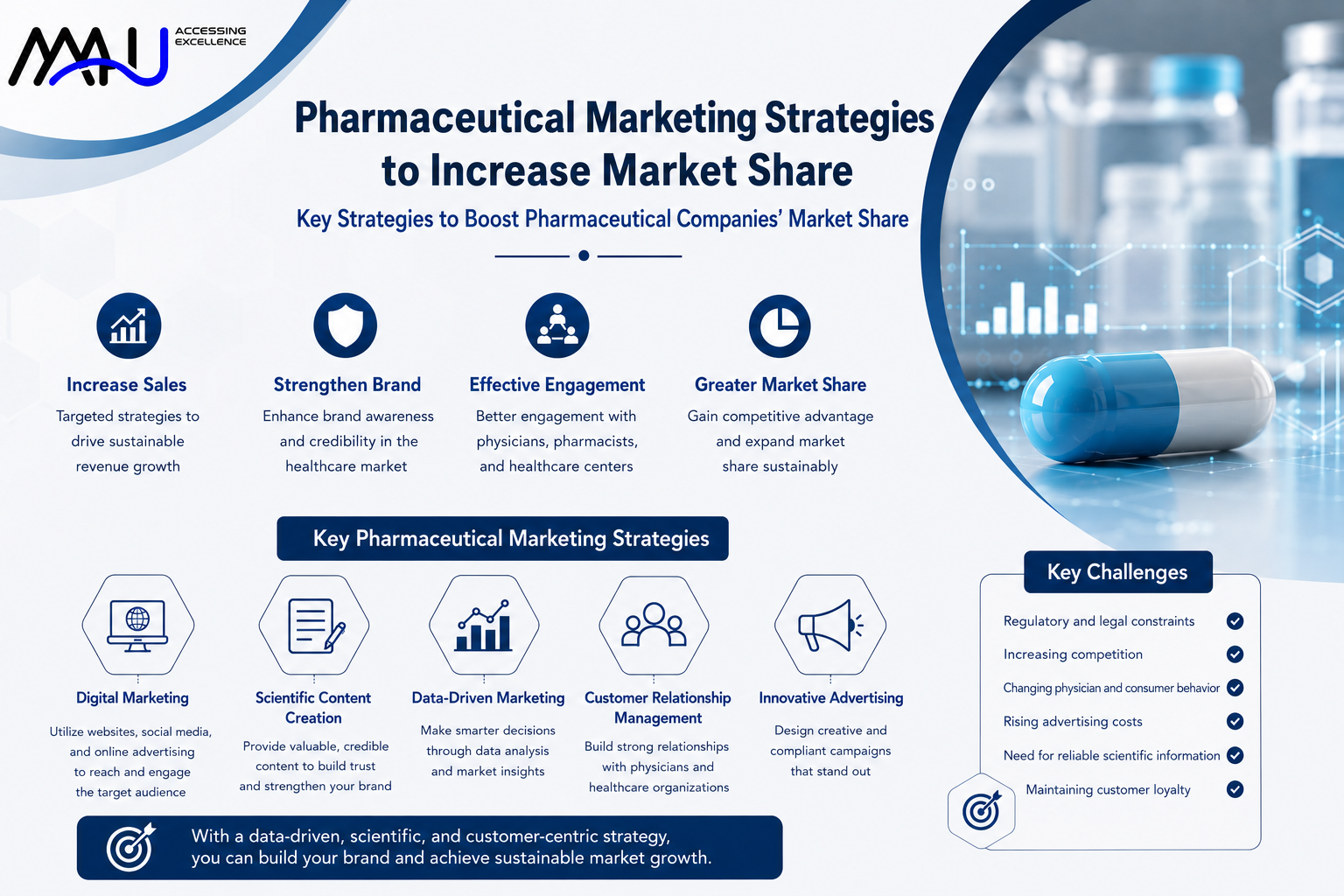
In today’s competitive world, using pharmaceutical marketing strategies has become one of the most important factors for the success of pharmaceutical companies. Organizations that leverage modern pharmaceutical marketing methods can better connect with physicians, pharmacists, healthcare centers, and patients, and gain a larger share of the market. Therefore, designing a scientific and data-driven pharmaceutical marketing strategy plays an important role in increasing sales, brand development, and sustainable growth of pharmaceutical companies.
What is pharmaceutical marketing and why is it important?
Pharmaceutical marketing is a set of targeted activities and programs carried out to introduce, promote, and expand the sales of pharmaceutical products. Unlike many industries, in the pharmaceutical market, the end consumer is not the only decision-maker; physicians, pharmacists, hospitals, distribution companies, and related organizations also play a role in the drug selection and prescription process.
Therefore, success in this industry requires designing a comprehensive pharmaceutical marketing strategy that considers the needs of all stakeholders. Companies that invest professionally in pharmaceutical marketing not only experience higher sales but also strengthen their brand credibility and position in the healthcare market.
Companies that invest professionally in marketing not only experience higher sales but also strengthen their brand credibility in the healthcare market. To learn more about the principles and methods of this field, you can study the complete pharmaceutical marketing guide.
Market changes and the need for modern strategies
The pharmaceutical market has undergone major changes in recent years. Increasing competition among brands, the growth of digital technologies, changes in audience behavior, and easier access to medical information have made traditional marketing methods less effective than before.
Today, physicians and healthcare professionals review extensive scientific information before making decisions about pharmaceutical products. Also, many audiences seek reliable information through websites, social networks, and online platforms. In such conditions, using a modern pharmaceutical marketing strategy can create a significant competitive advantage for pharmaceutical companies.

Key challenges in pharmaceutical marketing
Some common challenges in pharmaceutical marketing include:
- Regulatory and legal restrictions
- Intense competition among pharmaceutical brands
- Changing behavior of physicians and consumers
- Increasing advertising costs
- Need for reliable scientific information
- Difficulty in maintaining customer loyalty
Therefore, companies must continuously review and optimize their strategies.
Modern pharmaceutical marketing strategies
1. Pharmaceutical digital marketing
One of the most important trends in recent years is the use of digital marketing in the healthcare industry. Today, many pharmaceutical companies allocate part of their marketing budget to digital activities.
Specialized websites, social networks, online advertising, email marketing, and content campaigns are among the tools that can increase the effectiveness of pharmaceutical marketing strategies.
Benefits of pharmaceutical digital marketing:
- Increased brand awareness
- More effective communication with physicians
- Reduced marketing costs
- Accurate measurement of campaign results
- Improved audience conversion rate
2. Scientific and educational content production
Content is one of the most powerful pharmaceutical marketing tools. Physicians and healthcare professionals usually look for reliable scientific information, and companies that provide valuable content gain more trust in the market.
Examples of effective content include:
- Specialized articles
- Scientific reports
- Educational booklets
- Professional webinars
- Educational videos
- Case studies
Scientific content production not only enhances brand credibility but is also one of the most effective ways to strengthen pharmaceutical marketing strategy.
3. Data-driven marketing
Today, data has become one of the most valuable assets of companies. Using data analysis helps pharmaceutical companies better understand customer behavior, market trends, and campaign performance.
In a data-driven pharmaceutical marketing strategy, decisions are made based on real information rather than assumptions. This approach ensures better allocation of financial and human resources.
Applications of data analysis in the pharmaceutical industry:
- Market share analysis
- Sales performance evaluation
- Identifying growth opportunities
- Market trend forecasting
- Advertising campaign optimization
Companies that use marketing data analysis for decision-making usually achieve more accurate performance and higher efficiency in their campaigns.
The role of branding in increasing pharmaceutical market share
Branding is one of the most important pillars of success in the pharmaceutical industry. Many physicians consider brand credibility and reputation when selecting medications. Therefore, companies with stronger brand identities usually gain a larger market share.
Key elements of pharmaceutical branding
To succeed in pharmaceutical branding, the following must be considered:
- Professional visual identity
- Consistent brand message
- Scientific credibility
- Positive customer experience
- Effective communication with physicians and pharmacists
A successful pharmaceutical marketing strategy must consider branding as an inseparable part of marketing programs. Strong brands usually perform better in attracting new customers and retaining existing ones.
Omnichannel marketing; a solution for more effective audience engagement
Today, audiences use multiple channels to receive information. Some physicians prefer email communication, while others prefer webinars, specialized websites, or social networks.
Therefore, omnichannel marketing has become one of the most important parts of pharmaceutical marketing strategy.
In this approach, the brand message is delivered to the audience through multiple coordinated channels. This increases engagement, improves user experience, and strengthens audience trust.
Benefits of omnichannel marketing:
- Increased access to target audiences
- Improved customer experience
- Increased brand awareness
- Stronger interaction with physicians and pharmacists
- Higher conversion rate
- Improved marketing campaign effectiveness
The role of market research in pharmaceutical marketing success
One of the most important parts of any pharmaceutical marketing strategy is market research. Many pharmaceutical companies run marketing campaigns without a clear understanding of market needs, physician behavior, and competitor status. This can lead to wasted resources and reduced marketing effectiveness.
Pharmaceutical market research helps companies gain a more accurate picture of market conditions. This information may include demand levels, treatment needs, physician prescribing behavior, competitor performance, and new market opportunities.
Benefits of pharmaceutical market research
Market research offers many benefits for pharmaceutical companies:
- Identifying growth opportunities
- Better understanding of target audiences
- Reducing decision-making risk
- Optimizing marketing budget
- Increasing advertising campaign effectiveness
- Developing products aligned with market needs
Therefore, market research is one of the main foundations of modern pharmaceutical marketing and plays an important role in increasing market share.
The impact of artificial intelligence on pharmaceutical marketing strategy
Artificial intelligence has brought major transformation to the healthcare industry in recent years. Today, many pharmaceutical companies use AI-based tools for data analysis, communication personalization, and customer behavior prediction.
Using AI in pharmaceutical marketing strategy can bring several advantages:
More accurate data analysis
AI can analyze massive amounts of data in a short time and identify important patterns.
44
Communication personalization
Companies can design marketing messages tailored to each audience segment and increase engagement rates.
Market trend forecasting
AI-based market analysis can identify future opportunities and support better decision-making.
As a result, the use of modern technologies has become an important part of pharmaceutical marketing, and its role is expected to become even more significant in the coming years.
Common mistakes in pharmaceutical marketing
Some pharmaceutical companies, despite spending significant budgets, fail to achieve desired results. This is usually due to strategic mistakes in the marketing process.
Key mistakes include:
Excessive focus on short-term sales
Some brands focus only on immediate sales growth and neglect long-term relationships with physicians and healthcare centers.
Neglecting branding
Pharmaceutical branding plays an important role in building trust. Lack of investment in this area can reduce company competitiveness.
Failure to use market data
Decision-making without data analysis is one of the main reasons for campaign failure.
Weak content production
Scientific and educational content is one of the most effective pharmaceutical marketing tools. Companies that produce weak or non-specialized content lose many opportunities.
How to design a successful pharmaceutical marketing strategy?
Designing a successful pharmaceutical marketing strategy requires careful planning and a long-term perspective. Pharmaceutical companies must align their marketing activities with clear goals and measurable indicators.
Step 1: Market analysis
In this step, competitor status, market trends, and audience needs should be examined.
Step 2: Target audience definition
Accurate identification of physicians, pharmacists, healthcare centers, and other stakeholders plays an important role in marketing success.
Step 3: Choosing communication channels
Website, social networks, email marketing, webinars, and specialized events are among the most important communication channels in pharmaceutical marketing.
Step 4: Valuable content production
Scientific and educational content can increase audience trust and strengthen brand credibility.
Step 5: Evaluation and optimization
No successful strategy is complete without continuous monitoring and improvement. Reviewing campaign results and adjusting plans increases marketing effectiveness.
Comparison of traditional and modern marketing in the pharmaceutical industry
| Traditional marketing | Modern marketing |
| Focus on face-to-face advertising | Focus on customer experience |
| Limited audience interaction | Omnichannel communication |
| Limited data analysis | Data-driven decision making |
| Difficult performance measurement | Accurate performance measurement |
| Higher cost | Higher efficiency |
This shift shows that pharmaceutical companies must move toward modern strategies to remain competitive.
Conclusion
Today, success in the healthcare and pharmaceutical market depends more than ever on the quality of pharmaceutical marketing strategy. Using modern pharmaceutical marketing methods such as digital marketing, market research, scientific content production, branding, data analysis, and omnichannel marketing can help increase sales, expand markets, and improve brand positioning. Companies that approach marketing with a scientific and data-driven mindset have a higher chance of increasing market share and achieving sustainable growth.
If you are looking to design and implement a professional pharmaceutical marketing strategy, Mako, leveraging specialized experience in healthcare, market research, branding, digital marketing, and pharmaceutical scientific marketing, can support you. The Mako team, by providing data-driven solutions based on real market needs, helps pharmaceutical companies increase their market share, establish more effective communication with target audiences, and create a sustainable competitive advantage in the pharmaceutical industry.
Frequently Asked Questions
What is a pharmaceutical marketing strategy?
A set of targeted programs and actions to increase sales, develop brand, and grow market share of pharmaceutical products.
Why is pharmaceutical marketing important?
Because it helps pharmaceutical companies better introduce their products and communicate more effectively with target audiences.
What role does market research play in pharmaceutical marketing?
Market research helps identify opportunities, analyze competitors, and better understand customer needs.
How does digital marketing help pharmaceutical companies?
By increasing brand awareness, attracting target audiences, and accurately measuring campaign performance.
Do small pharmaceutical companies also need marketing strategies?
Yes, even small companies need marketing planning for sustainable growth and market share expansion.
Refrence
- https://www.iqvia.com/locations/united-states/library/articles/why-pharma-marketers-are-embracing-omnichannel-marketing?utm_source=chatgpt.com
- https://www.iqvia.com/locations/united-states/library/articles/achieving-success-in-pharma-marketing-the-need-for-a-personalized-omnichannel-approach?utm_source=chatgpt.com
- https://www.iqvia.com/blogs/2024/10/omnichannel-engagement-in-pharma?utm_source=chatgpt.com